


Financial planning has often relied on forecasts: estimate income, expenses, and investment growth, then build a plan around those assumptions. But a forecast can’t show every path money might take. Financial scenario planning adds a useful layer by asking what could change and how you would respond, before a surprise forces a rushed decision.
Use these eight questions to stress test your wealth plan against changes in work, markets, costs, borrowing, health, family needs, property, and personal goals. You don’t need to predict which event will happen. Instead, compare a baseline plan with plausible alternatives, then identify which choices would protect essential spending and keep your priorities within reach.
Gather a current view of your income, expenses, savings, debt, insurance, investments, and major goals. A spreadsheet is enough to start. For each scenario, note the financial effect, the resources available, and the decision you would take. Review the plan when circumstances change, rather than treating it as a fixed forecast.
Key Takeaways
- Compare plausible scenarios, not predictions: Stress test a baseline plan against possible changes in work, markets, costs, borrowing, health, family needs, property, and goals. For each, record the financial effect, available resources, and response.
- Protect essential spending during income shocks: Estimate essential monthly costs, accessible savings, and reliable income during a job transition. Decide which expenses could be reduced and which bills must stay current.
- Match investment risk to goals and timing: Test how a downturn could affect planned withdrawals and goal dates, especially when money is needed soon. Consider adjustments in advance rather than reacting abruptly to market movements.
- Revisit future costs and debt assumptions: Inflation can raise the cost of long-term goals, while higher borrowing costs can squeeze cash flow. Update savings targets and review loan payments, renewal dates, and refinancing assumptions.
- Include health and family needs in resilience planning: Review insurance limits and exclusions, potential care costs, and the effect of caregiving or family support on income and goals. Set workable boundaries and identify resources before needs become urgent.
1. How Would a Job Loss Affect Your Financial Plan?

Estimate how a job loss would change household income and how long available cash could cover essential expenses. Separate needs, such as housing, utilities, food, and insurance, from costs you could pause or reduce. Include any severance or other income only if you can reasonably rely on it, and consider how long finding replacement work might take without assuming a precise outcome.
Use this comparison to assess how long your household could cover essential costs after a job loss.
| Planning item | What to estimate | How it informs your plan |
|---|---|---|
| Essential monthly expenses | Housing, utilities, food, insurance, and other costs you would need to keep paying | Sets the minimum monthly amount your available funds may need to cover |
| Accessible cash and savings | Funds you could use without major costs or penalties | Compare this amount with essential expenses to estimate how long your cash reserve could last |
| Reliable income during a transition | Severance or other income you can reasonably expect, including its likely duration | Shows how much of the income gap might be covered without relying on uncertain sources |
| Flexible spending | Costs you could pause or reduce, such as discretionary purchases or optional services | Identifies practical ways to lower spending if replacement work takes longer than expected |
Estimate the impact on income, savings, and essential expenses
Compare monthly essential spending with cash savings and other funds you could access without major costs or penalties. For instance, if essential expenses were $5,000 a month and accessible savings were $30,000, those savings would equal six months of expenses before accounting for taxes, emergencies, or income support. The arithmetic is a planning illustration, not a guarantee of how long funds will last.
Write down which expenses you’d reduce first and which bills must stay current. Consider whether one income could support the household, and check what benefits or coverage might change when employment ends. This turns a broad concern into a practical response plan: protect cash flow, review spending, and avoid making long-term investment decisions under pressure.
2. What If Your Investments Lose Value?

Investment losses can affect both the value of your portfolio and the date you can use the money. Test your plan with a downturn rather than assuming markets will rise steadily. Consider which goals depend on investment withdrawals, whether you hold cash or other resources for near-term needs, and how a loss could influence your decisions.
Test how a market downturn could affect your goals and timeline
Review each goal by time horizon. Money needed soon may be more exposed to a forced sale during a fall in value than funds intended for a much later goal. Model a hypothetical 20% decline to see how your current portfolio and planned withdrawals might change; treat this as a stress test, not a prediction of future returns.
Then identify a response before volatility arrives. You might adjust spending, delay a flexible purchase, or revisit the timing of withdrawals. Avoid building the plan around a single market outcome or making abrupt changes solely because prices moved. A useful wealth scenario plan helps you understand trade-offs and stick to a strategy that fits your goals and tolerance for risk.
3. How Could Inflation Change Your Spending Power?

Inflation can make the same amount of money buy less over time. That matters when you’re planning for long-term expenses, such as housing, education, care, or retirement. Review both sides of your plan: future costs may rise, while the purchasing power of savings or fixed income may fall.
Reconsider future costs, savings targets, and income needs
List the major costs attached to each goal and ask which are most likely to change. Housing, energy, food, and care costs may not move at the same pace, so avoid using one broad assumption for every expense. If a future annual expense is $40,000 today, even a modest increase over many years could make the eventual target meaningfully higher.
Update savings targets when your expected costs, income, or time horizon changes. Also consider whether your plan has room to increase contributions or adjust discretionary spending. The aim isn’t to forecast prices perfectly. It’s to avoid treating today’s budget as a reliable measure of what a distant goal will cost.
4. What If Interest Rates or Borrowing Costs Rise?
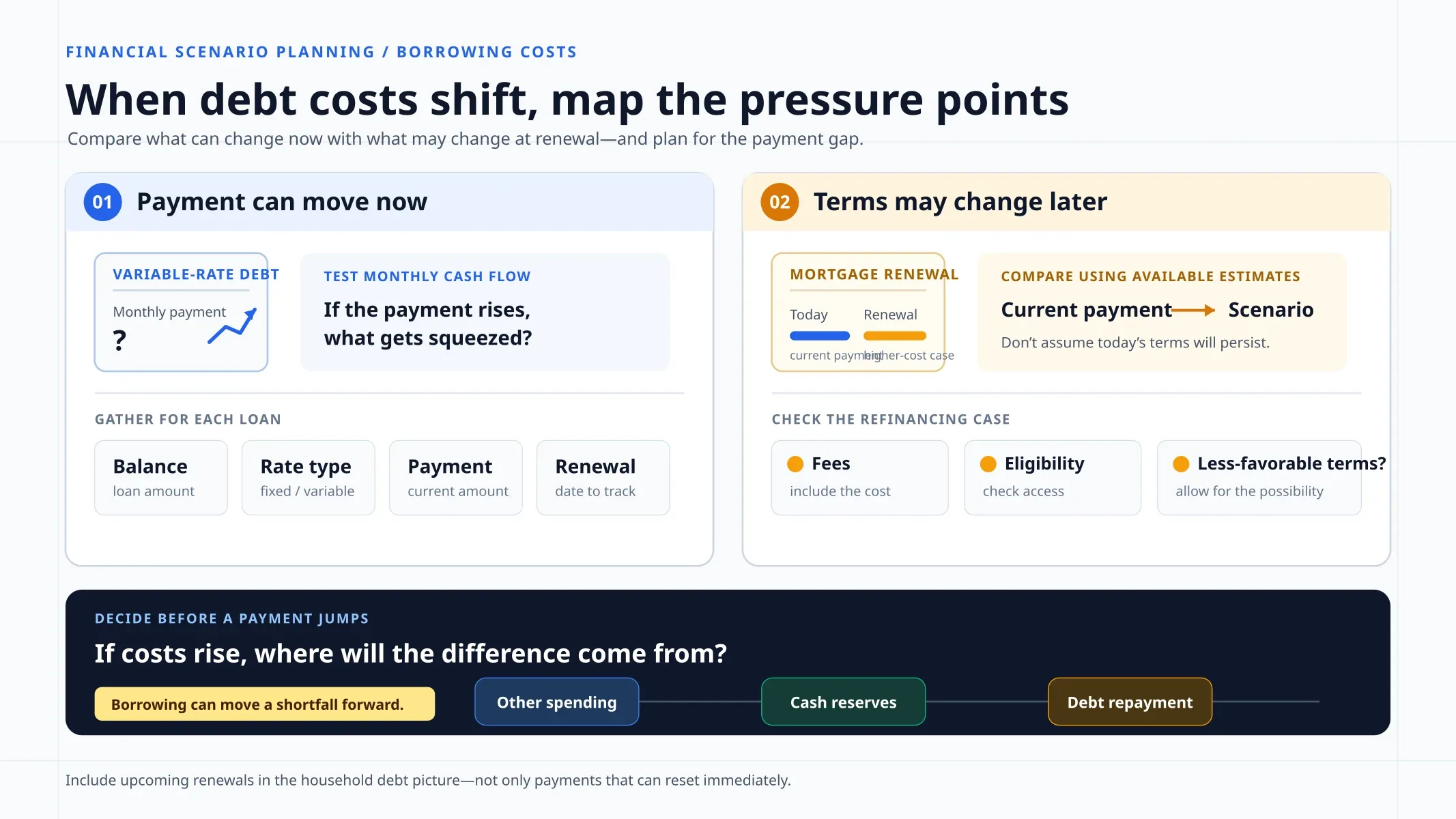
Higher borrowing costs can affect mortgage payments, variable-rate debt, and the price of refinancing. Review how much of your household budget depends on debt and whether a rate change would crowd out savings or essential spending. Include upcoming renewals, not just loans whose payments can change immediately.
Review mortgages, variable-rate debt, and refinancing assumptions
Gather each loan’s balance, rate type, payment, and renewal date. For variable-rate debt, ask how a higher payment would affect monthly cash flow. For a mortgage that will renew, compare your current payment with a higher-cost scenario using the lender’s available estimates, rather than assuming today’s terms will continue.
Check whether refinancing assumptions account for fees, eligibility, and the possibility that terms may be less favorable. If payments rise, decide in advance whether you’d cut other spending, use cash reserves, or make a different debt repayment choice. Don’t treat borrowing as an automatic fix for a shortfall; it can shift pressure into the future.
5. How Would a Major Health Expense Affect Your Wealth?

A serious health event can bring direct costs, time away from work, or additional care needs. Review how these effects could reach beyond medical bills and influence household income, savings, and support arrangements. The purpose is to find gaps in your financial protection, not to predict a particular illness or outcome.
Health-related financial resilience depends on more than insurance. Check what a policy covers, what it excludes, and how you’d manage costs or lost income that fall outside its terms.
Assess insurance coverage, emergency funds, and care costs
Read policy documents and confirm key details with the insurer or a qualified adviser. Check limits, deductibles, exclusions, waiting periods, and whether coverage depends on employment. Then consider accessible savings and possible nonmedical costs, such as travel for care, household help, or changes to your home.
Build a response that fits your circumstances. You could identify which savings are available, who to contact, and which bills need attention first. Avoid assuming that insurance will cover every expense or that savings can be accessed without consequences. If your needs are complex, a financial or insurance professional can help you review options.
6. What If You Need to Support Family Members?
Family support can be planned or unexpected: caregiving, education costs, or help during a period of financial difficulty. Set a clear view of what you could contribute without putting your own essential expenses and long-term goals at risk. A realistic boundary helps you offer support while keeping your household plan workable.
Plan for caregiving, education costs, or unexpected financial help
Separate recurring support from one-time help, and estimate the effect of each on monthly cash flow. For education, clarify which costs you intend to cover and when they may arise. For caregiving, consider both direct spending and reduced work hours. Discuss expectations with family where possible, since unclear commitments can make costs harder to manage.
Decide which goals could be adjusted if a need becomes urgent, and which resources you’d rather protect. You might set a limit, agree to review support after a set period, or coordinate contributions with other relatives. These choices aren’t easy, but considering them early can reduce rushed withdrawals or borrowing later.
7. How Could a Home or Business Setback Affect Your Plan?

A home repair or business setback can create a sudden cash need, interrupt income, or expose an overreliance on one asset. Consider how a large repair, lost revenue, or a decline in property or business value would affect your wider financial picture. Don’t assume that an asset can be sold quickly or at the value you expect.
Consider repairs, lost revenue, and concentrated asset risks
For a home, review maintenance needs, insurance coverage, and the cash available for repairs not covered by a policy. For a business, consider a period of weaker revenue, delayed payments, or an unexpected operating cost. If much of your wealth is tied to one property or business, note how that concentration could limit flexibility.
Identify backup resources and practical steps, such as reviewing contracts, maintaining relevant records, or setting aside funds for known maintenance. A business owner may also want to separate personal and business cash flow clearly. In either case, don’t count on borrowing or a quick sale as the only response.
8. What Changes If Your Goals or Timeline Shift?
Financial plans can change when priorities, family circumstances, or work plans change. A goal that once felt distant may become urgent, while another may matter less. Revisit your assumptions when the timing or purpose of a goal shifts, rather than continuing to follow a plan built for different circumstances.
Adjust priorities, milestones, and the assumptions behind your plan
List your goals in order of importance and record the target date, estimated cost, and resources assigned to each. Then ask what would happen if a goal moved forward by several years or were delayed. Check whether your savings rate, investment mix, and cash reserves still match the revised timeline.
Update one assumption at a time where possible, so you can see what is driving the change. If a new priority competes with an existing goal, compare the trade-offs rather than assuming both can be funded as before. A flexible plan makes it easier to redirect money deliberately while keeping essential needs and longer-term security in view.
Conclusion
Scenario planning for wealth is a practical way to prepare for change without pretending you can predict every outcome. Work through the eight questions, record the assumptions you used, and identify the action you’d take if a scenario affected your income, costs, assets, or goals. Focus first on essential spending, accessible resources, debt obligations, and the commitments you want to protect.
Keep your plan simple enough to update. A clear spreadsheet or written summary can show what changed, which choices remain open, and where you may need professional advice. Revisit it after a major life or financial change, and periodically check that your assumptions still reflect your circumstances.
Good financial scenario planning doesn’t remove uncertainty. It gives you a calmer, more deliberate way to respond, so a setback is less likely to turn into a rushed decision and your next step remains connected to the life you’re building.
Frequently Asked Questions
How do you choose which financial scenarios to test first?
How many scenarios should a financial plan include?
What is the difference between financial scenario planning and forecasting?
How often should you update a financial scenario plan?
How can you stress test a financial plan when you have limited savings?
Should financial scenarios include both short-term emergencies and long-term goals?
What should you do if several financial shocks happen at once?
How can you use financial scenario planning without treating it as a prediction?
Sources
- An essential guide to building an emergency fundhttps://www.consumerfinance.gov/an-essential-guide-to-building-an-emergency-fundConsumer Financial Protection Bureau guide to building an emergency fund.
- Scenario Planning for a Complex Retirement Outlookhttps://www.financialplanningassociation.org/article/journal/DEC11-scenario-planning-complex-retirement-outlookA December 2011 Journal of Financial Planning article on scenario planning for a complex retirement outlook.
- Scenario Analysis – Definition, Benefits & Step-by-Step Guidehttps://corporatefinanceinstitute.com/resources/financial-modeling/scenario-analysisCorporate Finance Institute guide defining scenario analysis and outlining its benefits and steps.
- What Is Scenario Planning? Strategy, Steps, and Practical Exampleshttps://www.netsuite.com/portal/resource/articles/financial-management/scenario-planning.shtmlNetSuite article introducing scenario planning, its strategy and steps, and practical examples.
- Emergency Savings and Financial Securityhttps://files.consumerfinance.gov/f/documents/cfpb_mem_emergency-savings-financial-security_report_2022-3.pdfConsumer Financial Protection Bureau report on emergency savings and financial security, including constraints that can make saving difficult.
- Which Factors Help Build Financial Resiliency in Lower-Incomehttps://files.consumerfinance.gov/f/documents/cfpb_financial-well-being_mgw-bufe_brief.pdfConsumer Financial Protection Bureau brief on factors that help build financial resilience among lower-income households.
- Unexpected job loss – Consumer Financial Protection Bureauhttps://www.consumerfinance.gov/consumer-tools/unexpected-job-lossConsumer Financial Protection Bureau resource about unexpected job loss.
- Investmenthttps://eliteisle.com/category/wealth/investment-strategies
- Inflationhttps://eliteisle.com/tag/inflation-hedge
- Buildhttps://eliteisle.com/money-and-freedom-build-an-emergency-fund-that-protects-your-life
